Choosing a smart lock for a front door is no longer just about replacing a traditional key with a phone app. For today’s residential market, a front door smart lock has to balance physical security, smart access convenience, platform compatibility, installation fit, and long-term durability. For brands, distributors, project suppliers, and hardware retailers, this topic matters because buyers are increasingly comparing not only lock features, but also how well a smart lock works with their existing door hardware and smart home ecosystem.
A good smart front door lock should do four things well: protect the entrance, fit the door correctly, support convenient daily access, and remain reliable over time. That means the selection process should include both the electronic side—such as app control, fingerprint access, Matter compatibility, and remote credential management—and the mechanical side, including lock grading, weather resistance, backset compatibility, and door thickness fit. A lock that is “smart” but physically weak is not a strong front-door solution. It is just a gadget with a confident marketing team.
Below is a practical guide to choosing a smart lock for a residential front door, including which features to compare, how different smart lock types work, how to verify compatibility with existing door hardware, and what certifications and durability standards should be checked before purchase.
🔍 1. What Features Should You Compare When Selecting a Smart Lock?
The most effective smart locks combine security, usability, smart integration, and backup access options.
Wichtige Funktionen im Vergleich
When evaluating smart locks for front door use, prioritize these elements:
- ANSI/BHMA grade
- Zugriffsmethoden
- App-Funktionalität
- Akkulaufzeit
- Smart-Home-Kompatibilität
- Witterungsbeständigkeit
- Notfall-Zugriff
- Unterstützung bei Firmware-Updates
These features influence both the lock’s technical performance and the end user’s daily experience.
Key feature comparison table
Below is a structured overview of the most important smart lock features to compare:
| Funktion | Warum das wichtig ist | What to Look For |
|---|---|---|
| ANSI/BHMA grade | Indicates mechanical security and durability | Prefer Klasse 1 or strong 2. Klasse for front doors |
| Access method | Affects convenience and user behavior | Fingerprint, keypad, app, NFC/card, physical key backup |
| App control | Enables remote management | Guest access, logs, remote unlock, alerts, firmware updates |
| Smart ecosystem support | Determines automation compatibility | Apple Home, Alexa, Google Home, SmartThings, Matter |
| Battery system | Impacts reliability | Long battery life, low-battery alerts, emergency power backup |
| Weather resistance | Important for exterior exposure | Outdoor-rated construction, corrosion-resistant finish, IP rating |
| Backup entry method | Reduces lockout risk | Mechanical key, keypad, external power port |
This comparison helps filter out locks that may look advanced on paper but fail to meet practical front-door requirements.
Security should come before convenience
Many users focus first on app features or unlocking style, but front door selection should begin with:
- physical lock strength
- Türkompatibilität
- durability for daily use
- resistance to weather and tampering
A polished app is useful. A strong and properly fitted lock is non-negotiable.
🧠 2. How Do Fingerprint, Keypad, App-Controlled, and Key Card Smart Locks Differ?
Different smart lock types serve different user needs. In practice, many premium models combine more than one access method.
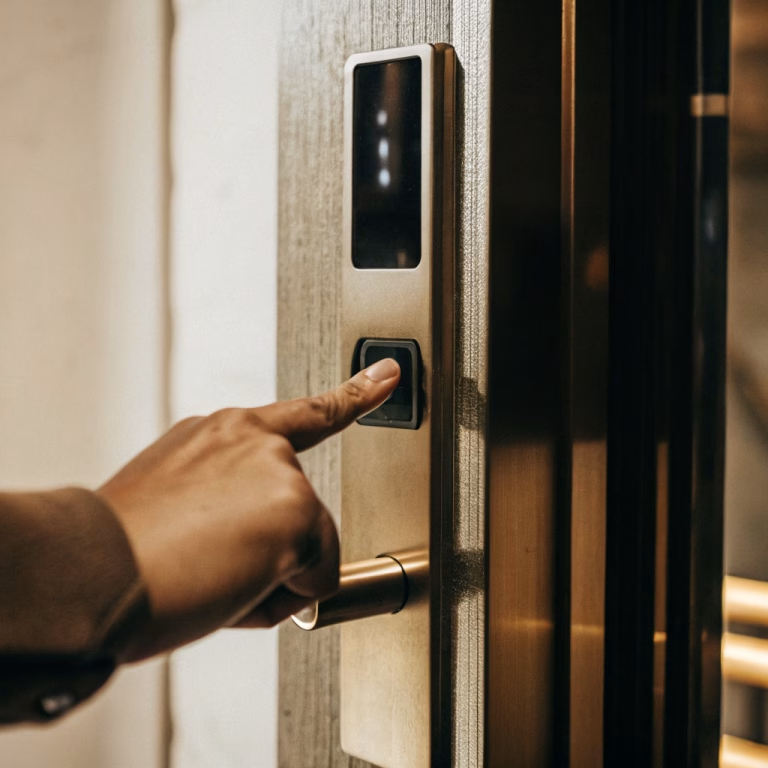
Smart-Schlösser mit Fingerabdruckerkennung
Fingerprint locks use biometric sensors to identify authorized users.
Wichtigste Vorteile:
- schnelles Entsperren
- kein Schlüssel erforderlich
- no PIN to remember
- user-specific enrollment
Am besten geeignet für:
- families
- owner-occupied homes
- users who want phone-free entry
Things to verify:
- sensor speed
- sensor accuracy
- wet-finger performance
- number of stored fingerprints
- alternative Zugriffsmethode
Fingerprint access is often the fastest day-to-day option, especially for households that want convenience without depending entirely on a smartphone.
Smart-Schlösser mit Tastenfeld
Keypad locks use numeric PIN codes for entry.
Wichtigste Vorteile:
- easy family sharing
- useful for children or guests
- simple temporary code management
- no fingerprint sensor dependency
Am besten geeignet für:
- families
- short-term rental properties
- homes with frequent visitor access
Things to verify:
- keypad durability
- backlit keypad visibility
- code length and user capacity
- anti-peep or random-digit security features
For many users, keypad locks remain one of the most practical front door solutions because they are intuitive and flexible.
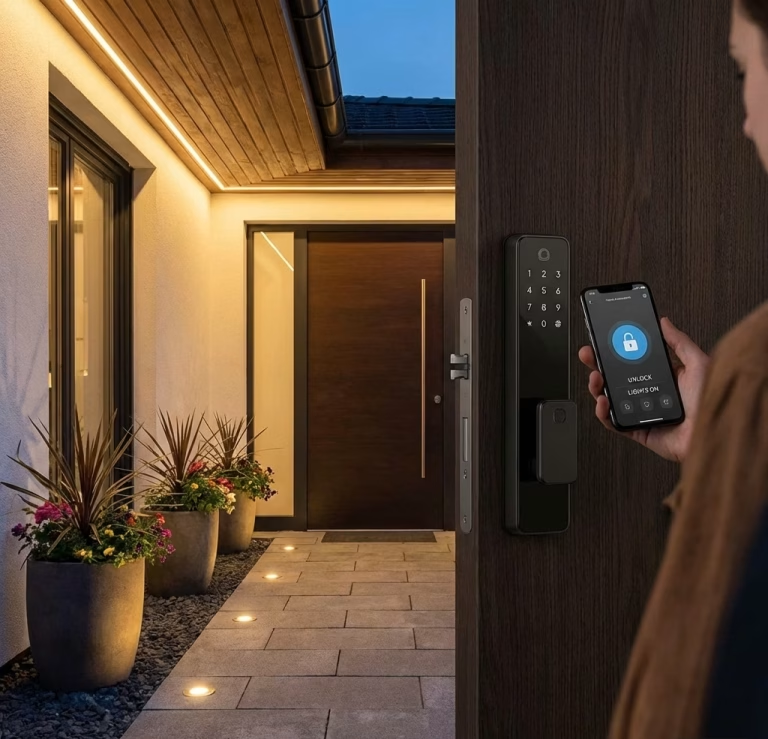
App-gesteuerte Smart Locks
App-enabled locks focus on remote management and connected home control.
Wichtigste Vorteile:
- Fernverriegelung und -entriegelung
- Zugriffsprotokolle
- guest management
- push notifications
- Firmware-Updates
- Smart-Home-Automatisierung
Am besten geeignet für:
- connected households
- second homes
- remote management scenarios
- users who value monitoring and control
Things to verify:
- App-Stabilität
- cloud dependence
- Bluetooth vs Wi-Fi operation
- notification quality
- account security
This type is strongest when users want more than local unlocking and need visibility into who entered and when.
Key card or NFC smart locks
These locks use:
- NFC-Karten
- RFID-Zugangsdaten
- Apple Home Key in compatible systems
Wichtigste Vorteile:
- tap-to-unlock convenience
- no manual code entry
- easy credential sharing in some systems
- smooth user experience for premium homes
Am besten geeignet für:
- Apple-focused households
- users who prefer tap access
- high-end residential entry systems
Things to verify:
- card or credential management
- NFC reliability
- compatibility with Apple Home Key or other ecosystems
- backup methods if card access fails
Practical access-method summary
Here is a simpler side-by-side comparison:
| Schlossart | Hauptvorteil | Main Limitation |
|---|---|---|
| Fingerabdruck | Fast, phone-free entry | Sensor quality varies by model |
| Tastatur | Einfacher gemeinsamer Zugriff | Codes can be shared too widely |
| App-controlled | Remote access and monitoring | May depend more on connectivity |
| Key card / NFC | Fast tap access | Usually less universal than keypad |
In many cases, the best smart lock is not the one with one “perfect” method, but the one with multiple reliable ways to unlock.
🚪 3. How Can You Ensure Compatibility with Existing Front Door Hardware?
A smart lock must fit both the door und die existing hardware preparation.
Mechanical compatibility checklist
Before purchasing, verify the following:
- Türstärke
- Türsturz
- Bohrlochdurchmesser
- cross bore / latch spacing
- door handing if relevant
- deadbolt-only or handleset configuration
- Türmaterial
- interior clearance for thumbturn module
Most residential smart locks are designed for standard doors, commonly within:
- 1-3/8 inch to 1-3/4 inch thickness
- 2-3/8 inch or 2-3/4 inch backset
However, compatibility should always be checked model by model.
Retrofit vs full replacement smart locks
There are two broad installation categories.
Retrofit smart locks
These mount over the existing interior thumbturn while keeping the current exterior deadbolt hardware.
Vorteile:
- easier installation
- minimal visual change
- existing keys remain usable
- good for rental or non-invasive upgrades
Am besten geeignet für:
- users who want simple installation
- homes with compatible existing deadbolts
- projects that prefer minimal door modification
Full replacement smart locks
These replace the deadbolt or full front lockset.
Vorteile:
- more integrated appearance
- more features
- more control over lock design and finish
- stronger upgrade path for new hardware systems
Am besten geeignet für:
- new purchases
- full door hardware upgrades
- buyers who want better design consistency and expanded access options
Smart ecosystem compatibility matters too
Beyond physical fit, smart lock buyers should confirm compatibility with their preferred system:
- Apple-Startseite
- Google Home
- Amazon Alexa
- Samsung SmartThings
- Matter-enabled platforms
For a ToB website, this is especially important because consumers increasingly shop by ecosystem rather than by lock body alone.
Compatibility mistakes to avoid
Common problems include:
- buying a lock that does not fit the existing backset
- ignoring door thickness limits
- assuming all smart locks support Wi-Fi out of the box
- confusing app support with full smart home integration
- overlooking whether a hub or bridge is required
These are small details at purchase time and very large details during installation.
🛡️ 4. What Security Certifications and Durability Standards Should You Verify?
For a front door smart lock, certifications and test standards are essential signals of quality.
ANSI/BHMA-Klassifizierung
This is one of the most important benchmarks for the mechanical side of a smart lock.
| Note | General Meaning | Typische Anwendung |
|---|---|---|
| Klasse 1 | Höchste Langlebigkeit und Sicherheit | Best for demanding residential or light commercial entry |
| 2. Klasse | Starke Entwicklung im Wohnimmobilienbereich | Suitable for many front door applications |
| 3. Klasse | Grundlegendes Wohnniveau | Better suited to lower-demand applications |
For front door use, a Klasse 1 lock is generally the strongest option, while a good 2. Klasse model may still be suitable for many homes depending on security expectations and usage level.
Weather resistance and exterior suitability
A front door lock must withstand environmental exposure.
Auf Folgendes prüfen:
- corrosion-resistant finishes
- outdoor-rated construction
- UV-Beständigkeit, sofern relevant
- IP rating if provided
- stable performance in heat, cold, and humidity
This matters especially for exterior entries exposed to rain, sun, coastal air, or large temperature swings.
Battery reliability and emergency power support
A connected lock is only useful if it remains operational.
Achten Sie auf:
- Warnungen bei niedrigem Akkustand
- long battery life
- emergency power contact or USB backup
- physical key override where applicable
Battery design often affects real-world user satisfaction more than buyers expect.
Cybersecurity features
Smart front door locks should also be evaluated as connected devices.
Verify whether the product provides:
- verschlüsselte Kommunikation
- secure account authentication
- Unterstützung bei Firmware-Updates
- Manipulationswarnungen
- local fallback access if connectivity is lost
The goal is not just to make the door smarter, but to avoid making the entry point digitally careless.
📦 5. What Should Buyers and ToB Suppliers Check Before Purchasing?
For a ToB website, practical buying guidance is one of the most useful content angles because it helps customers compare products with more confidence.
Pre-purchase checklist
Bitte überprüfen Sie vor dem Kauf Folgendes:
- the smart lock type
- the supported access methods
- ANSI/BHMA certification level
- Kompatibilität mit der Türstärke
- Kompatibilität mit dem Achsabstand
- weather suitability
- ecosystem support
- whether Wi-Fi is built in or requires a hub
- battery type and backup access method
- warranty and firmware support
For bulk or channel purchasing
If purchasing multiple units, it is wise to verify:
- technische Dokumentation
- Montageanleitung
- compatibility chart
- Zertifizierungsunterlagen
- Verfügbarkeit von Ersatzteilen
- app support history
- long-term firmware maintenance
- after-sales support quality
Sample testing before rollout
For projects, channel sales, or product line evaluation, sample testing is highly recommended.
A test installation should verify:
- fit on the actual door
- Ausrichtung der Verriegelung
- Erfahrungen bei der Einrichtung der App
- access speed
- Verhalten der Batterie
- user experience with the selected entry methods
This is often the difference between a smooth product rollout and a support inbox that develops its own weather system.
✅ Fazit
Choosing a smart lock for a front door requires more than comparing app screenshots or unlocking styles. The right product should combine strong mechanical security, reliable smart access, door compatibility, durable outdoor performance, and credible certification support.
For most buyers, the best evaluation process is simple:
- Start with security and fit
Check ANSI/BHMA grade, door thickness, backset, and hardware compatibility first. - Choose the right access method mix
Compare fingerprint, keypad, app, and NFC/card options based on how the household actually enters. - Confirm smart ecosystem support
Make sure the lock works with Apple Home, Alexa, Google Home, Matter, or other preferred platforms. - Verify durability and backup access
Look for weather resistance, battery alerts, emergency power options, and fallback entry methods. - Review documentation before buying
Check certifications, installation details, firmware support, and warranty coverage—especially for bulk purchasing.
A well-chosen smart front door lock can improve residential security, access convenience, user control, and overall smart home experience while reducing installation problems and long-term support issues.
FAQ
You should compare physical security grade, access methods, app functionality, battery life, smart home compatibility, weather resistance, and backup unlock options. For a front door, both security and long-term reliability are just as important as convenience.
Each type has different advantages. Fingerprint locks offer fast personal access, keypad locks are simple for families and guests, app-controlled locks provide remote management, and key card or NFC locks support tap-to-unlock convenience. Many of the best smart locks combine more than one access method for better flexibility.
Check the door thickness, backset, bore hole size, deadbolt configuration, door material, and interior clearance. You should also confirm whether the smart lock is a retrofit model or a full replacement model before purchasing.
A retrofit smart lock installs over your existing deadbolt on the inside of the door and keeps the current exterior hardware. A full replacement smart lock replaces the entire deadbolt or lockset and usually offers a more integrated appearance and broader feature set.