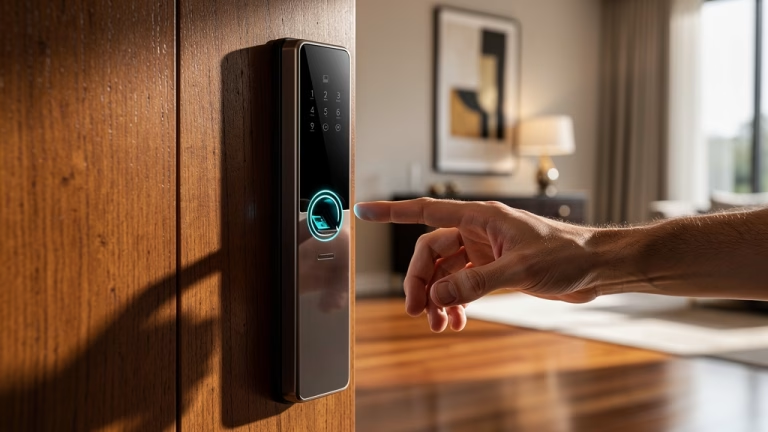
The difference between a prueba de fallos y fail-secure automatic door locks is the lock’s response when electrical power is lost:
- A fail-safe lock unlocks or releases when power is removed.
- A fail-secure lock remains locked on the access side when power is removed.
Fail-safe prioritizes release and access continuity, while fail-secure prioritizes protection against unauthorized entry. Neither configuration is universally better. The correct choice depends on the door’s function, emergency-egress requirements, fire strategy, security risk, access-control architecture, backup power, and locally adopted codes.
One point is especially important:
Fail-safe and fail-secure normally describe the condition of the secure or access side of a door—not whether occupants can exit from inside.
A properly configured fail-secure electric strike or electrified lock can keep the exterior side locked during an outage while still providing mechanical free egress through an inside lever or exit device.
Fail-Safe vs. Fail-Secure at a Glance
The power-loss state is the primary distinction, but it affects several parts of the door and access-control strategy.
| Característica | Fail-Safe Lock | Fail-Secure Lock |
|---|---|---|
| State when power is removed | Unlocks or releases | Remains locked on the access side |
| Typical electrical logic | Power to lock | Power to unlock |
| Primary priority | Release, passage, or life-safety strategy | Perimeter or restricted-area security |
| Power consumption | Often continuously powered while locked | Often powered only during release, depending on design |
| Outage result | Access control at that opening may be lost | Unauthorized entry remains restricted |
| Interior egress | Must be evaluated as part of the assembly | Can remain mechanically available |
| Common examples | Electromagnetic locks and some electrified locksets | Many electric strikes and electrified locksets |
| Aplicaciones típicas | Selected egress, re-entry, and emergency-release openings | Exterior, storage, server-room, and restricted-area doors |
| Main risk | Door may become accessible during an outage | Authorized entry may require backup power or mechanical override |
These are general tendencies. The exact operating sequence must be confirmed from the manufacturer’s wiring diagram and technical data.
What Do “Fail-Safe” and “Fail-Secure” Mean?
The words can be misleading because safe sounds better than secure. In access control, however, they describe two different electrical operating modes rather than overall product quality.
What is a fail-safe lock?
A fail-safe lock depends on electrical power to maintain its locked condition.
Its simplified operating logic is:
1、Power applied → Door locked
2、Power removed → Lock releases
Power may be intentionally removed by:
- An authorized credential
- A request-to-exit device
- A fire-alarm signal
- An emergency release button
- An access-control command
- A building-management system
- A loss of mains power
- A failed power supply
- A disconnected or damaged cable
An electromagnetic lock is the clearest example. The magnet generates holding force while energized. When power disappears, the magnetic holding force disappears as well.
Fail-safe behavior can support emergency release, but it also creates a security consideration: unless backup power or another locking method is provided, a power failure may leave the access side unlocked.
What is a fail-secure lock?
A fail-secure lock remains locked on the access side without electrical power.
Its simplified operating logic is:
No power → Access side locked
Power applied → Access side temporarily unlocked
A fail-secure electric strike, for example, may use a powered solenoid to release its keeper. If power fails, the keeper remains secured and continues to retain the latchbolt.
Fail-secure behavior helps maintain perimeter or restricted-area protection during a blackout. However, authorized users may need one of the following to enter:
- Anulación mecánica mediante llave
- Battery-backed access control
- Emergency power
- Generator power
- A separate approved entrance
- Manual intervention by authorized personnel
Which side does the terminology describe?
Fail-safe and fail-secure normally describe the secure side, also called the:
- Access side
- Key side
- Outside side
- Locked side
They do not automatically describe operation from the egress side.
For example, a fail-secure electrified mortise lock may keep the outside lever locked without power while the inside lever mechanically retracts the latch at all times.
This distinction can be summarized as:
Entry behavior and egress behavior are related, but they are not the same specification.
What Happens During a Power Failure?
Power failure should be considered as a complete system event—not merely a lock event. The lock, controller, reader, sensors, fire-alarm interface, network equipment, and backup power may all behave differently.
Fail-safe sequence
During normal operation:
- The power supply energizes the lock.
- The lock remains secured.
- A valid credential or release signal interrupts power.
- The lock releases.
- The door opens.
- Power is restored and the door relocks after closing.
During a power failure:
- Electrical power is interrupted.
- The lock releases.
- The door may remain physically closed but is no longer electrically secured.
- Access-control monitoring may continue only if the controller and sensors have backup power.
- The opening returns to controlled operation when power is restored, subject to system programming.
A released lock does not necessarily mean the door swings open. A door closer may keep it closed, and a separate mechanical latch may still operate depending on the hardware design.
Fail-secure sequence
During normal operation:
- The door remains locked on the access side.
- A valid credential sends a release signal.
- Power operates the strike, lever, latch, or actuator.
- The authorized user opens the door.
- The hardware returns to its locked condition after the release period.
During a power failure:
- The controller or power supply loses power.
- The lock remains secured on the access side.
- Interior mechanical egress may remain available.
- Authorized exterior entry may require a key or backup-power system.
- Access-control logging and remote release may be unavailable unless the system is backed up.
What happens when power returns?
Power-restoration behavior should be defined during system design and commissioning.
Questions to resolve include:
- Does a fail-safe lock relock immediately?
- Must the access controller reboot first?
- Is door position checked before relocking?
- Does the controller retain schedules and permissions?
- Is a manual reset required after a fire alarm?
- Will a motorized lock automatically return to its previous state?
- Are alarms generated for doors that remain open?
- Does the system create an audit event for the outage?
An unexpected relocking sequence can create operational or safety problems. It should be tested, documented, and included in staff training.
Does Fail-Secure Mean People Cannot Exit?
No. This is one of the most common misunderstandings in electrified door hardware.
A fail-secure device can maintain security against outside entry while an occupant exits through:
- A mechanically operable inside lever
- Panic hardware
- Fire-exit hardware
- A push pad
- An approved mechanical release
- Another code-compliant egress arrangement
For example, consider a fail-secure electric strike paired with a mechanical mortise lock:
- From outside, the strike controls whether the latch can pass through the keeper.
- From inside, the lever mechanically retracts the latch.
- If power fails, the strike remains locked against entry.
- The inside lever can still allow egress.
The complete assembly—not the term fail-secure—determines whether egress is available.
Special locking arrangements
Some systems do not provide ordinary mechanical free egress and may be subject to additional requirements. Examples can include:
- Cerraduras electromagnéticas
- Delayed-egress locking systems
- Controlled-egress systems
- Sensor-release locks
- Certain institutional locking arrangements
- Access-controlled elevator-lobby doors
- Special-purpose security doors
These systems may require specific release devices, signage, alarm interfaces, time delays, emergency controls, or approval by the authority having jurisdiction.
Does Fail-Safe Automatically Make a Door Code-Compliant?
No. A fail-safe product can still be installed in a noncompliant system.
For example, an electromagnetic lock may release when power is removed, but the opening may also require:
- A listed sensor that detects an approaching occupant
- A request-to-exit switch
- Direct interruption of lock power
- A clearly identified manual release device
- Fire-alarm or sprinkler-system interface
- Release upon loss of power
- Correct emergency-unlock timing
- Required signage
- Compliant mounting height
- Suitable emergency-power logic
Requirements depend on the locking arrangement, occupancy, door location, adopted code, and local enforcement.
A fail-safe label answers only one question:
What happens to the electrical lock when its power is removed?
It does not establish that the complete door assembly provides compliant egress.
Common Types of Electrified Door Locks
Several lock categories may be available in fail-safe, fail-secure, or product-specific configurations.
Cerraduras eléctricas
An electric strike is installed in the frame, inactive leaf, or mullion. Its keeper controls whether the latchbolt can pass through the strike.
Electric strikes are commonly available as:
- A prueba de fallos
- A prueba de fallos
- Field-selectable
- Fire-rated or non-fire-rated configurations
- Standard or monitored models
Potential advantages include:
- Compatibility with existing mechanical locksets
- Continued mechanical operation of the inside lever
- Relatively straightforward retrofit installation
- Low power consumption in many fail-secure configurations
- Availability of latch and door monitoring options
Compatibility must be checked for the latch type, preload, door handing, frame material, fire rating, and required egress function.
Electrified mortise locks
An electrified mortise lock integrates an electrical actuator into a mortise lock case.
Depending on the model, power may control:
- Outside lever locking
- Outside lever unlocking
- Retroceso del pestillo
- Deadbolt monitoring
- Request-to-exit output
- Door or latch status
A common arrangement keeps the inside lever mechanically operable while electrically controlling the outside lever.
Electrified mortise locks are often used in:
- Commercial offices
- Hoteles
- Universities
- Centros sanitarios
- Government buildings
- High-traffic institutional openings
Electrified cylindrical locks
The electrified cylindrical locks use a bored-lock chassis and electrically control the outside lever or another internal function.
They can be suitable for:
- Oficinas
- Storerooms
- Classrooms
- Puertas interiores con control de acceso
- Light-to-heavy commercial applications
Buyers should verify duty cycle, voltage, current draw, handing, door preparation, monitoring options, and emergency mechanical operation.
Cerraduras electromagnéticas
An electromagnetic lock uses an energized magnet and an armature plate to hold the door closed.
Its typical behavior is:
- Power present: magnet produces holding force
- Power removed: holding force disappears
For this reason, electromagnetic locks are generally associated with fail-safe operation.
Their advantages can include:
- No conventional latch engagement
- High advertised holding force
- Simple electrical release
- Suitability for selected glass or architectural doors
Important design concerns include:
- Mandatory release methods
- Fire-alarm interface
- Request-to-exit logic
- Alineación de puertas
- Residual magnetism
- Door-position monitoring
- Correct armature installation
- Backup-power strategy
- Egress-code compliance
Holding force alone does not determine whether a magnetic-lock installation is secure or compliant.
Dispositivos de salida electrificados
Exit devices may use electrical options such as:
- Electric latch retraction
- Electrified outside trim
- Alarmed exit
- Request-to-exit monitoring
- Delayed egress
- Remote dogging, where permitted
- Motorized latch retraction
The fail-safe or fail-secure state depends on which component is electrified and how the device is configured. The push pad may continue to provide mechanical egress even if outside access remains locked.
Motorized and smart locks
Motorized locks use an electric motor or geared actuator rather than relying only on a solenoid or magnet.
They may include:
- Funcionamiento con batería
- Anulación mecánica mediante llave
- Thumbturn override
- Remote access
- Credenciales móviles
- Cloud management
- Lock-state monitoring
- Low-battery warnings
- Automatic relocking
For these products, a prueba de fallos y fail-secure may not fully describe every failure mode. Buyers should ask what happens during:
- Mains-power loss
- Battery depletion
- Network loss
- Controller failure
- Motor failure
- Credential-reader failure
- Firmware malfunction
- Fire-alarm activation
A battery-powered smart lock may remain mechanically locked when its battery is depleted but lose electronic credential processing. That behavior should not be assumed; it must be verified for the exact model.
When Should You Choose a Fail-Safe Lock?
A fail-safe lock should be considered when automatic release during power loss is part of the building’s safety or operational strategy.
Typical fail-safe priorities
Fail-safe may be appropriate when:
- Electrical locking must release when power is lost
- Emergency responders require automatic access
- The door must unlock upon a fire-alarm signal
- Emergency passage is more important than maintaining exterior security
- The application uses an electromagnetic lock
- A stairwell re-entry strategy requires remote unlocking
- The adopted code requires the electrical locking function to release
Potential applications
Depending on the approved design, fail-safe hardware may be considered for:
- Selected stairwell doors
- Certain internal circulation doors
- Some healthcare or controlled-egress applications
- Public entrances that must release in an emergency
- Access-controlled doors connected to a fire-alarm system
- Doors using electromagnetic locking systems
These are examples, not universal rules. A stairwell, hospital, or public entrance can contain several door functions with different requirements.
Advantages of fail-safe operation
- Automatically releases if lock power is lost
- Can support emergency-access strategies
- Integrates naturally with fire-alarm release
- Avoids dependence on powered unlocking during an outage
- May simplify certain emergency-unlock sequences
Limitations of fail-safe operation
- Can leave a perimeter or restricted area unsecured
- Often requires continuous power to remain locked
- May increase power consumption and heat generation
- Can depend heavily on battery backup for security continuity
- Damaged wiring may cause unintended release
- May require additional monitoring and alarm functions
A fail-safe lock should therefore be paired with a realistic security plan for outages and cable faults.
When Should You Choose a Fail-Secure Lock?
Fail-secure is generally preferred when unauthorized entry must remain restricted during a power outage.
Typical fail-secure priorities
Consider fail-secure when:
- The door protects assets or sensitive information
- Perimeter security must remain during outages
- The outside must stay locked if the controller fails
- A mechanical inside lever or exit device provides free egress
- Authorized staff can use mechanical key override
- Backup power is available for continued credential access
Potential applications
Fail-secure hardware is commonly considered for:
- Commercial exterior doors
- Almacenes
- Salas de servidores
- Data centers
- Records rooms
- Pharmaceutical storage
- Cash-handling areas
- Staff-only offices
- Restricted laboratories
- Residential smart-lock entrances
- Utility and equipment rooms
Advantages of fail-secure operation
- Maintains access-side security without electrical power
- Reduces the risk of an outage automatically opening the perimeter
- Often consumes power only during authorized release
- Can operate with mechanical free egress
- Can be combined with key override or emergency power
Limitations of fail-secure operation
- Electronic entry may stop during a power failure
- Emergency responders may require an alternative access method
- Backup power may be necessary for business continuity
- Poorly designed configurations can create egress hazards
- Staff can be locked out if no mechanical override exists
- Remote unlocking may be unavailable when the controller is offline
Fail-secure should never be interpreted as permission to trap occupants. Egress remains a separate and essential requirement.
Security, Egress, Fire Safety, and Access Control
Choosing the correct mode requires balancing four different objectives.
Seguridad
From an unauthorized-entry perspective, fail-secure often has an advantage during an outage because it remains locked on the access side.
However, overall security also depends on:
- Door and frame strength
- Lock construction
- Strike reinforcement
- Seguridad de las credenciales
- Reader protection
- Wiring protection
- Controller location
- Door-position monitoring
- Forced-door alarms
- Mechanical key control
- Ciberseguridad
- Backup power
A fail-secure lock installed in a weak frame is not a secure opening. Similarly, a fail-safe lock with monitored backup power may provide better overall security than a poorly designed fail-secure system.
Emergency egress
Egress design should answer:
- Can an occupant exit without a key?
- Is special knowledge required?
- Is more than one releasing operation required?
- Is panic hardware required?
- Does the egress function remain available during power loss?
- Does the fire alarm affect the lock?
- Is manual emergency release required?
- Is delayed egress permitted at this location?
- Does the door release in the correct direction?
Most conventional fail-secure electric strikes and electrified locksets can preserve mechanical egress. Magnetic locks and special locking arrangements require additional attention because the lock may directly prevent opening until electrically released.
Fire safety
Fail-safe, fail-secure, and fire-rated are separate concepts.
- Fail-safe or fail-secure: describes electrical behavior during power loss.
- Fire-rated: describes suitability within a tested or listed fire-door assembly.
- Free egress: describes how occupants can leave.
- Positive latching: describes whether the door remains latched as required.
- Fire-alarm release: describes how the access-control system responds to an alarm.
A fire door may need to unlock for egress while still closing and positively latching to resist the spread of fire and smoke.
Therefore, unlocking does not necessarily mean:
- Holding the door open
- Retracting the latch indefinitely
- Disabling the closer
- Preventing positive latching
The lock, latch, closer, exit device, wiring, and alarm interface must operate as a coordinated assembly.
Access control
The access-control system may include:
- Lector de credenciales
- Door controller
- Lock power supply
- Fire-alarm interface
- Request-to-exit sensor
- Door-position switch
- Latch monitor
- Emergency release
- Network connection
- Management software
- Batería de reserva
- Mechanical override
The lock’s fail mode should align with the controller’s relay logic and power-supply design. Incorrect use of normally open and normally closed circuits can reverse the intended behavior—a tiny wiring detail with a very large personality.
Application-Based Selection Guide
Different doors in the same building may require different modes.
| Solicitud | Typical Direction | Main Considerations |
|---|---|---|
| Commercial exterior entrance | Often fail-secure | Perimeter protection, key override, backup power |
| Interior office door | Either | Security level, free egress, operating schedule |
| Server or data room | Often fail-secure | Outage security, monitoring, emergency access |
| Warehouse entrance | Often fail-secure | Asset protection, exterior access, mechanical override |
| Stairwell door | Project-specific | Re-entry, remote unlocking, adopted code |
| Fire-rated exit door | Project-specific | Listing, positive latching, egress, alarm interface |
| Hospital department | Door-specific | Patient safety, staff security, controlled egress |
| Pharmacy or medication room | Often fail-secure | Restricted access and auditability |
| Hotel guestroom | Product-specific | Battery behavior, mechanical override, fire requirements |
| Hotel stair or exit door | Project-specific | Re-entry, egress, fire strategy |
| School classroom | Door-specific | Lockdown, emergency egress, staff access |
| Residential entrance | Often secure on battery failure | Key or thumbturn override, low-battery warning |
| Glass entrance with maglock | Usually fail-safe | Emergency release and code-compliant egress |
| High-security facility | Engineered solution | Threat assessment, redundancy, monitoring, code |
These are common design tendencies—not substitutes for an approved hardware schedule.
Choosing by Building Type
A single building can legitimately use both fail-safe and fail-secure locks.
Commercial offices
Commercial buildings often use:
- Fail-secure perimeter entrances
- Fail-secure server and records rooms
- Electrified locksets with mechanical inside egress
- Selected fail-safe magnetic locks
- Fire-alarm-linked emergency release
The hardware should be scheduled door by door according to function and risk.
Centros sanitarios
Healthcare environments can contain:
- Public entrances
- Patient rooms
- Pharmacies
- Infant-care areas
- Behavioral-health spaces
- Staff-only rooms
- Operating areas
- Emergency departments
- Stairwells
A pharmacy may prioritize fail-secure protection, while a selected circulation or controlled-egress opening may require a different emergency response. Patient safety, staff intervention, and specialized egress rules must be evaluated.
Hoteles
Hotel access systems may include:
- Battery-powered guestroom locks
- Fail-secure staff-area locks
- Electrified service entrances
- Fire-rated stair doors
- Public entrances with automatic operators
- Emergency-release interfaces
Guestroom locks require careful battery-management and mechanical-override procedures. Stair and exit doors require separate life-safety evaluation.
Schools and universities
Educational facilities may need:
- Classroom security
- Lockdown functions
- Free egress
- Staff key override
- Monitored exterior entrances
- Stairwell re-entry
- Fire-alarm integration
Lockdown objectives must not override required emergency egress.
Warehouses and industrial buildings
Fail-secure hardware is often preferred for:
- Exterior doors
- Inventory areas
- Tool rooms
- Control rooms
- Utility spaces
- Restricted production areas
High traffic, dust, temperature, vibration, and door misalignment should be included in product selection.
Residential and multifamily buildings
Smart residential locks may use batteries instead of a continuously powered access-control circuit. Buyers should verify:
- Low-battery warning period
- State after complete battery depletion
- Exterior emergency-power terminals
- Anulación mecánica mediante llave
- Interior thumbturn operation
- Remote-access behavior during network loss
- Auto-lock timing
- Fire and egress requirements for the building type
The marketing term smart lock does not explain its failure behavior. The operating sequence still matters.
How Backup Power Changes the Decision
Backup power can maintain access-control operation during an outage, but it does not change the lock’s inherent fail mode after backup power is exhausted.
Common backup-power options
- Local rechargeable battery
- Access-control power-supply battery
- Uninterruptible power supply
- Central emergency-power system
- Building generator
- Redundant power supplies
Questions to ask
- How long must the system operate during an outage?
- What is the total current draw?
- Are locks powered continuously or only during release?
- Are controllers, readers, and network switches also backed up?
- Is the fire-alarm interface backed up?
- What happens when the battery reaches low voltage?
- Is battery health monitored?
- How often are batteries tested and replaced?
- Does emergency power alter fire-alarm release behavior?
A fail-safe magnetic lock may consume power continuously, affecting required battery capacity. A fail-secure strike may use less energy but still need backup power if credentials must continue working during an outage.
Electrical and Technical Specifications to Compare
B2B buyers should review more than the fail mode.
Voltage and current
Common product inputs may include:
- 12 VDC
- 24 VDC
- Dual-voltage operation
- Product-specific AC supply
Verifícalo:
- Holding current
- Activation current
- Inrush current
- Continuous-duty rating
- Power-supply capacity
- Voltage drop over cable distance
- Polarity requirements
- Surge suppression
An undersized power supply or excessive voltage drop can produce intermittent unlocking, coil overheating, or unreliable relocking.
Duty rating
Ask whether the solenoid or actuator is suitable for:
- Intermittent duty
- Continuous duty
- High-frequency operation
- Extended energized periods
A component intended for momentary release may overheat if continuously powered.
Monitoring outputs
Useful monitoring functions include:
- Door-position status
- Latchbolt status
- Deadbolt status
- Request-to-exit
- Lock status
- Tamper status
- Power status
Monitoring allows the system to distinguish between a valid access event and a door that has been forced or held open.
Rendimiento medioambiental
Confirm:
- Operating temperature
- Humidity limits
- Outdoor suitability
- Ingress protection
- Corrosion resistance
- Dust resistance
- Condensation protection
- Use in washdown or coastal environments
Mechanical compatibility
Compruébalo:
- Door and frame material
- Door handing and swing
- Latchbolt dimensions
- Strike preparation
- Preload tolerance
- Door sag and alignment
- Exit-device compatibility
- Fire-rating restrictions
- Required door gap
- Faceplate dimensions
Electrical compatibility cannot rescue incorrect mechanical preparation. The lock still has to fit the door—a stubbornly physical requirement in an increasingly digital world.
Fire and Life-Safety Standards
Commercial specifications should identify the applicable code, standard edition, product listing, and jurisdiction.
ANSI/BHMA electrified hardware standards
The ANSI/BHMA standards cover relevant categories of electrified locking hardware and performance testing. ANSI/BHMA A156.41 is commonly referenced in relation to door-hardware electrified locking devices.
Before citing a grade or compliance claim, verify:
- Exact standard title
- Current edition
- Exact product category
- Tested model
- Test report or certification
- Applicable function and configuration
A family-level claim should not be assumed to cover every voltage, monitoring option, faceplate, or fail-mode configuration.
International Building Code
En 2024 International Building Code includes provisions relevant to:
- Vías de evacuación
- Electrically locked doors
- Sensor-release systems
- Door-hardware release
- Stairway doors
- Accesibilidad
- Fire and smoke protection
The applicable section depends on the exact locking arrangement and door function.
NFPA 101
NFPA 101, Life Safety Code, addresses life-safety strategies for new and existing structures, including means-of-egress considerations.
The NFPA source currently identifies the 2024 edition as active. Projects must follow the edition adopted by the relevant jurisdiction, which may differ.
NFPA 80
NFPA 80, Standard for Fire Doors and Other Opening Protectives, addresses installation and maintenance of assemblies used to protect openings against fire and smoke spread.
The NFPA source currently identifies the 2025 edition as active. Again, the legally applicable edition is the one adopted for the project.
Authority having jurisdiction
The authority having jurisdiction may include:
- Building department
- Fire marshal
- Code official
- Insurance authority
- Government agency
- Facility owner’s safety authority
Product selection and installation should be reviewed against the locally adopted requirements. An online article or general selection table cannot approve a specific opening.
Step-by-Step Selection Process
A structured process reduces specification errors and costly field changes.
1. Define the door’s function
Identify whether the opening is primarily:
- An entrance
- An exit
- A perimeter door
- An internal access-control point
- A stairwell door
- A fire-rated opening
- A restricted-room entrance
- A residential entrance
- A controlled-egress door
2. Define the required power-loss state
Ask:
If all normal and backup power disappears, should the access side unlock or remain locked?
- Choose a fail-safe direction when automatic release is required.
- Choose a fail-secure direction when exterior security must remain.
This preliminary decision must still be checked against egress and fire requirements.
3. Define interior egress
Specify exactly how occupants exit during:
- Normal operation
- Access-control failure
- Power failure
- Fire alarm
- Emergency lockdown
- Network failure
Do not rely on assumptions about the fail mode.
4. Identify the door and hardware type
Record:
- Material de la puerta
- Frame material
- Single or double door
- Sentido de apertura de la puerta
- Resistencia al fuego
- Tipo de cierre
- Latch or exit device
- Automatic operator
- Door closer
- Existing preparation
5. Select the electrified device
Compara:
- Electric strike
- Electrified mortise lock
- Electrified cylindrical lock
- Electromagnetic lock
- Electrified exit device
- Motorized lock
- Smart battery-powered lock
The best device depends on security, egress, installation, traffic, aesthetics, and maintenance.
6. Design the control sequence
Document what happens when:
- A valid credential is presented
- An invalid credential is presented
- The request-to-exit device activates
- The fire alarm activates
- Normal power fails
- Backup power expires
- A door is forced
- A door is held open
- The controller goes offline
- Power is restored
A written sequence of operations is one of the most useful documents in an access-control project.
7. Confirm backup access
For fail-secure doors, provide an appropriate method such as:
- Mechanical key cylinder
- Emergency power
- Batería de reserva
- Generator supply
- Secure key box where approved
- Staffed alternative entrance
8. Verify listings and standards
Check the exact hardware combination, including:
- Lock
- Strike
- Exit device
- Door and frame
- Fuente de alimentación
- Release device
- Fire-alarm interface
- Automatic operator
- Sensors and controls
9. Obtain regulatory approval
Coordinate with the project’s architect, security consultant, fire-protection engineer, code consultant, and authority having jurisdiction.
10. Test and commission the opening
Test at minimum:
- Valid and invalid credentials
- Mechanical egress
- Anulación mecánica mediante llave
- Mains-power loss
- Backup-power depletion
- Fire-alarm release
- Emergency-release button
- Door-held-open alarm
- Forced-door alarm
- Power restoration
- Automatic relocking
- Controller and network failure
Document results for facility management and future maintenance.
Common Specification Mistakes
Several errors occur repeatedly in access-control projects.
Mistake 1: Assuming fail-secure prevents egress
Fail-secure usually describes access-side behavior. A mechanical inside lever or exit device can still provide free egress.
Mistake 2: Assuming fail-safe guarantees compliance
Fail-safe behavior does not replace required release devices, alarm interfaces, listings, signage, or approved egress hardware.
Mistake 3: Using one mode throughout the building
A server room, public entrance, pharmacy, stair door, and fire exit have different priorities. Specify each opening by function.
Mistake 4: Ignoring total power failure
Designers sometimes consider mains failure but overlook depleted batteries, failed generators, damaged wiring, or controller shutdown.
Mistake 5: Forgetting mechanical override
A fail-secure door without backup power or mechanical entry can prevent authorized access during an extended outage.
Mistake 6: Confusing unlock with unlatch
Some devices unlock a lever, while others retract a latch or release a keeper. These actions produce different operating results.
Mistake 7: Ignoring positive latching on fire doors
Releasing access control must not unintentionally defeat required closing and latching functions.
Mistake 8: Selecting by holding force alone
A high holding-force claim does not establish door compatibility, egress compliance, frame strength, or complete-opening security.
Mistake 9: Omitting the power-restoration sequence
Immediate or uncontrolled relocking after an outage can create operational problems.
Mistake 10: Treating software status as physical lock status
A controller may report “locked” even if the door has not closed or the latch has not engaged. Door-position and latch monitoring provide better verification.
B2B RFQ Checklist
The following information helps AKADASMART prepare an accurate technical proposal.
| Category | Information to Provide |
|---|---|
| Building | Occupancy type, country, jurisdiction, and project stage |
| Door | Material, size, handing, swing, frame, and fire rating |
| Function | Entrance, exit, perimeter, stair, restricted room, or controlled egress |
| Fail mode | Required state during mains and total power failure |
| Egress | Lever, push pad, panic hardware, sensor release, or other arrangement |
| Tipo de cierre | Strike, mortise, cylindrical, magnetic, motorized, or smart lock |
| Método de acceso | Card, PIN, mobile, biometric, key, or mixed credentials |
| Potencia | Voltage, power supply, UPS, battery, generator, and required runtime |
| Integration | Fire alarm, automatic operator, BMS, intercom, and access controller |
| Monitoring | Door position, latch status, request to exit, and tamper detection |
| Medio ambiente | Interior, exterior, temperature, humidity, corrosion, and ingress |
| Compliance | Required standards, listings, code edition, and approval authority |
| Comercial | Quantity, drawings, samples, packaging, and delivery schedule |
A Practical Decision Matrix
This matrix provides a preliminary selection direction. It does not replace code review.
| Requirement | Fail-Safe | Fail-Secure |
|---|---|---|
| Unlock automatically when lock power is lost | ✓ | |
| Maintain exterior security during power loss | ✓ | |
| Typical electromagnetic-lock operation | ✓ | |
| Typical restricted-room strategy | ✓ | |
| Mechanical free egress can be provided | ✓ | ✓ |
| Fire-alarm release can be integrated | ✓ | Product and application dependent |
| Continuous power commonly required to stay locked | ✓ | Usually not |
| Mechanical override especially important | Useful | Strongly recommended |
| Backup power needed for continued credential access | Often | Often |
| Suitable for every exit door by default | ||
| Suitable for every fire door by default |
The absence of a checkmark does not mean a configuration is impossible. It means the system requires product-specific engineering and regulatory review.